
Criminal Court Records in Franklin County
A criminal court record is the full case file the court clerk opens once formal charges are filed against a person. It is not a single sheet. It grows as the case moves, collecting the charging paper, the docket of every filing and hearing, the orders a judge signs, the plea or verdict, and the final sentence. In Franklin County the clerk who holds the file depends on which court has the case. Felony files that reach Circuit Court are kept by Circuit Clerk Warren Walker. Misdemeanor and initial felony matters are tracked at the Justice Court level.
Franklin County criminal cases move through more than one court. Justice Court is the first stop for many of them. It handles misdemeanors, DUI, county ordinance violations, and the initial appearance and affidavit stage of felony cases. Felonies later move to Circuit Court District 6 after a grand jury returns an indictment, and the Circuit Court is where felony trials, pleas, and sentencing take place. The State is represented by District Attorney Tim Cotton in felony matters and by County Prosecuting Attorney Mary K. Williamson in justice and county court matters and certain appeals.
The duties of a Justice Court judge are spelled out in a Mississippi State University Extension guide to elected Justice Court judges, which describes the misdemeanor and initial-appearance work that starts many criminal files.
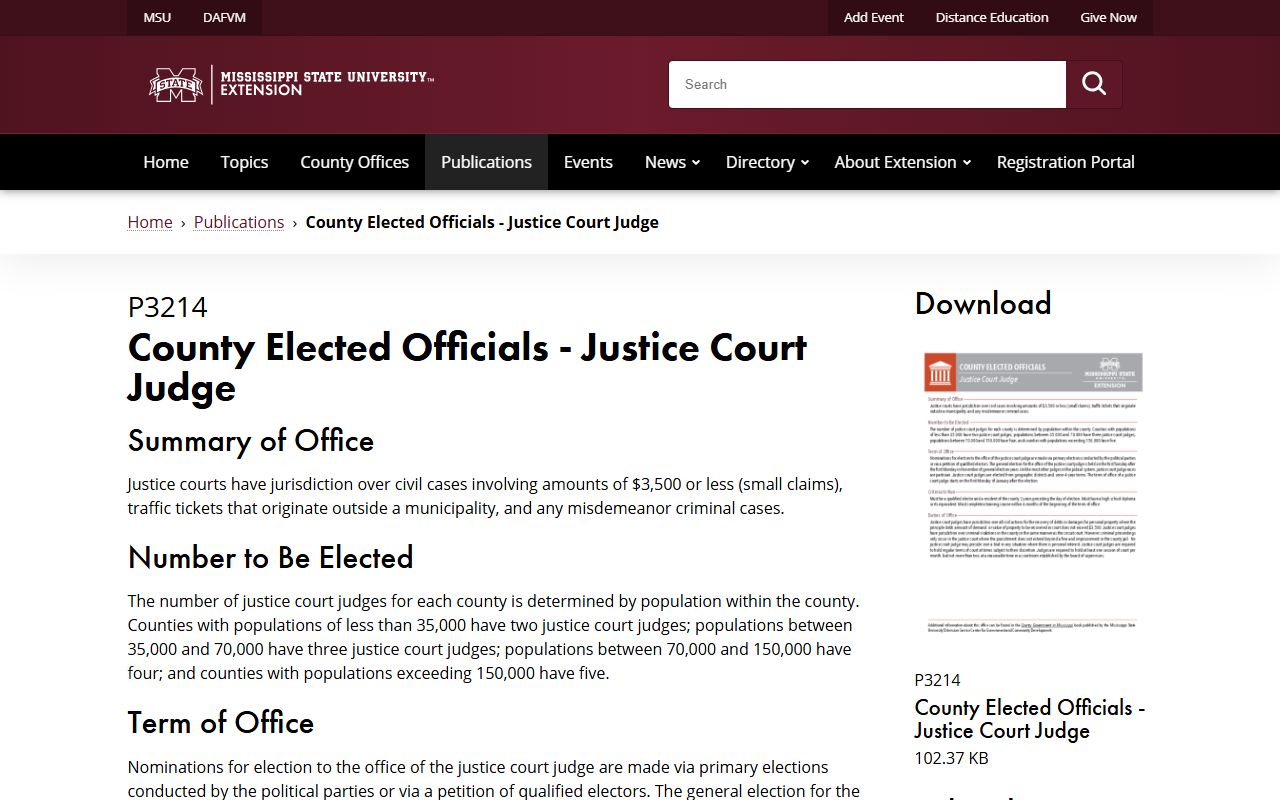
That first court level matters because it shapes where the early record lives before a felony is indicted and sent up to Circuit Court.
How to Search Franklin County Criminal Court Records
Franklin County does not run its own online case-search website. The statewide route is Mississippi Electronic Courts, searched by the public through Public Access Mississippi Electronic Case Management, known as PAMEC. All Circuit, Chancery, and County Courts in the state e-file into this system, so eligible Franklin County Circuit Court criminal dockets can be viewed by a registered public user. Access requires a login, an annual public registration fee, and a per-page charge to view documents.
- Register for a public PAMEC account through the Mississippi Electronic Courts public registration page and accept the non-attorney terms of use.
- Log in and search by defendant name or by cause number for the felony case.
- Narrow the search to the participating court, the case type, and a filing date range.
- Open the case to read the docket entries, the charges, and the disposition.
- Request a certified copy from Circuit Clerk Warren Walker when a stamped, court-ready document is needed.
When PAMEC asks for payment or shows no remote access, the file may still exist. Call the clerk who holds it. The Mississippi Electronic Courts general information page explains what the public account covers and where local clerks remain the better channel for older, certified, or restricted records.
Note: A PAMEC account shows electronic trial-court records, but sealed cases and certain restricted categories may not appear online even when the underlying case is real.
Stages of a Franklin County Criminal Case
A criminal case in Franklin County follows a path, and each step leaves a mark in the record. The path often starts with a sworn affidavit in Justice Court. The arrested person gets an initial appearance, and Justice Court judges hold sessions at the jail three times each week so that appearance happens within three days of arrest. Felonies then go to a grand jury. If the grand jury indicts, the case moves to Circuit Court, where the defendant is arraigned, enters a plea, and either resolves the case by plea or goes to trial.
Case flow: Affidavit or Charges Filed in Justice Court › Initial Appearance › Grand Jury and Indictment › Arraignment in Circuit Court › Plea or Trial › Disposition › Sentencing
The plain-English process steps behind these early stages are laid out at Mississippi Justice Court Help, a statewide guide to how lower-court criminal matters begin.

Each event in that flow becomes a docket entry, so the record reads like a timeline of the case.
| Stage | What Happens |
|---|---|
| Initial Appearance | The arrested person is told the charges and bond is set, held at the jail within three days of arrest. |
| Indictment | A grand jury reviews felony evidence and decides whether to formally charge, sending the case to Circuit Court. |
| Arraignment | The defendant is read the indictment in Circuit Court and enters a plea of guilty or not guilty. |
| Plea or Trial | The case ends in a negotiated plea or proceeds to a jury or bench trial before a Circuit judge. |
| Sentencing | After a guilty plea or verdict, the judge orders the sentence, fines, costs, and any restitution. |
What a Franklin County Criminal Court Record Shows
The criminal case file is built from standard fields. Mississippi pleadings label the matter with a cause number, name the court and the assigned judge, and list the parties as the State of Mississippi against the defendant. The docket then records every filing in order, from the indictment and motions to the final judgment. Financial fields capture fines, court costs, bond, and restitution. The record also notes when identifiers such as Social Security numbers, dates of birth, and the names of minor children are protected from public view.
| Field | What It Shows |
|---|---|
| Cause Number | The unique case identifier assigned by the court that opened the file. |
| Defendant | The person charged, listed opposite the State of Mississippi as the prosecuting party. |
| Charges | Each offense as filed, tied to a statute, with its level as felony or misdemeanor. |
| Plea | The defendant's formal answer, such as guilty, not guilty, or no contest. |
| Disposition | The outcome of each charge, such as dismissed, convicted, or acquitted. |
| Sentence | The penalty ordered, including jail or prison time, probation, fines, and restitution. |
Older Franklin County criminal files may not be digitized. For those, the clerk with custody can search by name, cause number, or filing date.
Charges vs. Convictions in Franklin County
Being charged is not the same as being convicted. A charge is an accusation that the State must still prove. A conviction is a finding of guilt by plea or verdict. A Franklin County criminal court record can show charges that were later dropped, dismissed, reduced, or ended in acquittal, and those entries stay in the public file even when they did not lead to a conviction. Reading the disposition for each separate charge, not just the case caption, is the only reliable way to know how the matter ended.
| Charge | Conviction | |
|---|---|---|
| Stage | Accusation | Verdict or plea |
| Burden of Proof | Probable cause | Beyond reasonable doubt |
| Public Record | Yes | Yes |
A closer look at the charges themselves, including how a prosecutor amends or drops them, lives on the Franklin County arrest records and court charges page.
Reading Dispositions and Sentences
The disposition is the heart of a criminal record. Common entries include guilty, not guilty, dismissed, and nolo contendere, which is a no-contest plea. A case may also be passed to the file or held in abeyance while conditions are met. The sentence follows a conviction and can combine prison or jail time, probation, fines, court costs, and restitution to a victim. In Franklin County, a felony sentence served in state custody is administered by the Mississippi Department of Corrections, while shorter terms may be served locally.
Each charge in a multi-count case carries its own disposition and sentence. One count can end in conviction while another is dismissed.
Sealed vs. Expunged Records
Sealing and expunging are not the same. A sealed record is hidden from public view but still exists, and a court order is normally needed to inspect it. An expunged record is removed from public access and treated as though the charge or conviction never happened. In Mississippi, Miss. Code Ann. § 99-19-71 is the key criminal expunction statute. It allows certain first-offense misdemeanors and one qualifying felony conviction to be expunged after the sentence and waiting periods are complete, while excluding listed serious offenses.
An expunction is filed in the court where the case was handled. The Mississippi expungement overview from a state district attorney's office explains who may qualify and how the petition works.

After a judge signs an expunction order, the record is removed from public channels and a search may return no public result.
| Sealed | Expunged | |
|---|---|---|
| Visibility | Hidden from public | Destroyed or treated as never existed |
| Law Enforcement | Limited access | Very limited |
| Eligibility | By court order in restricted categories | Eligible misdemeanor or one qualifying felony under Miss. Code 99-19-71 |
Public Access to Franklin County Criminal Court Records
Most criminal case files are public in Mississippi. The Public Records Act treats government records as open for inspection unless a specific law exempts them, and court files are also governed by court rules, sealing orders, and remote-access limits. The practical rule in Franklin County is simple. Ask the office that holds the record. Circuit Court felony files start with the Circuit Clerk, and Justice Court misdemeanor and initial-appearance records start with Justice Court.
Key Statutes:
Mississippi Code § 25-61-1 - public records are open for inspection unless a specific law exempts them.
Mississippi Code § 25-61-5 - public bodies must adopt written procedures for handling records requests.
Background Check Considerations
A casual name search and a regulated background check are different things. Court dockets and public case files can answer a personal question, but they are not a substitute for a formal report ordered for hiring, housing, or lending. Those reports follow federal rules and must use verified, current data. Anyone making such a decision should rely on a compliant consumer reporting agency, not an informal lookup.
Important: This site is not a consumer reporting agency under the Fair Credit Reporting Act, and its information may not be used for credit, employment, housing, or other FCRA-regulated decisions.
Restricted Criminal Court Records in Franklin County
Some criminal matters are kept out of public view. Youth Court records are confidential under Mississippi law, with access limited to court staff, parties, attorneys, guardians, law enforcement, and others a statute or judge allows. Sealed cases, expunged cases, and ongoing investigations may also be withheld. Records that involve minors or sensitive personal identifiers are redacted before release.
The confidentiality of youth matters comes from Miss. Code Ann. § 43-21-251 and related sections. The Mississippi Bar guide to the rights of juveniles who are arrested explains how youth cases are handled differently from adult cases.
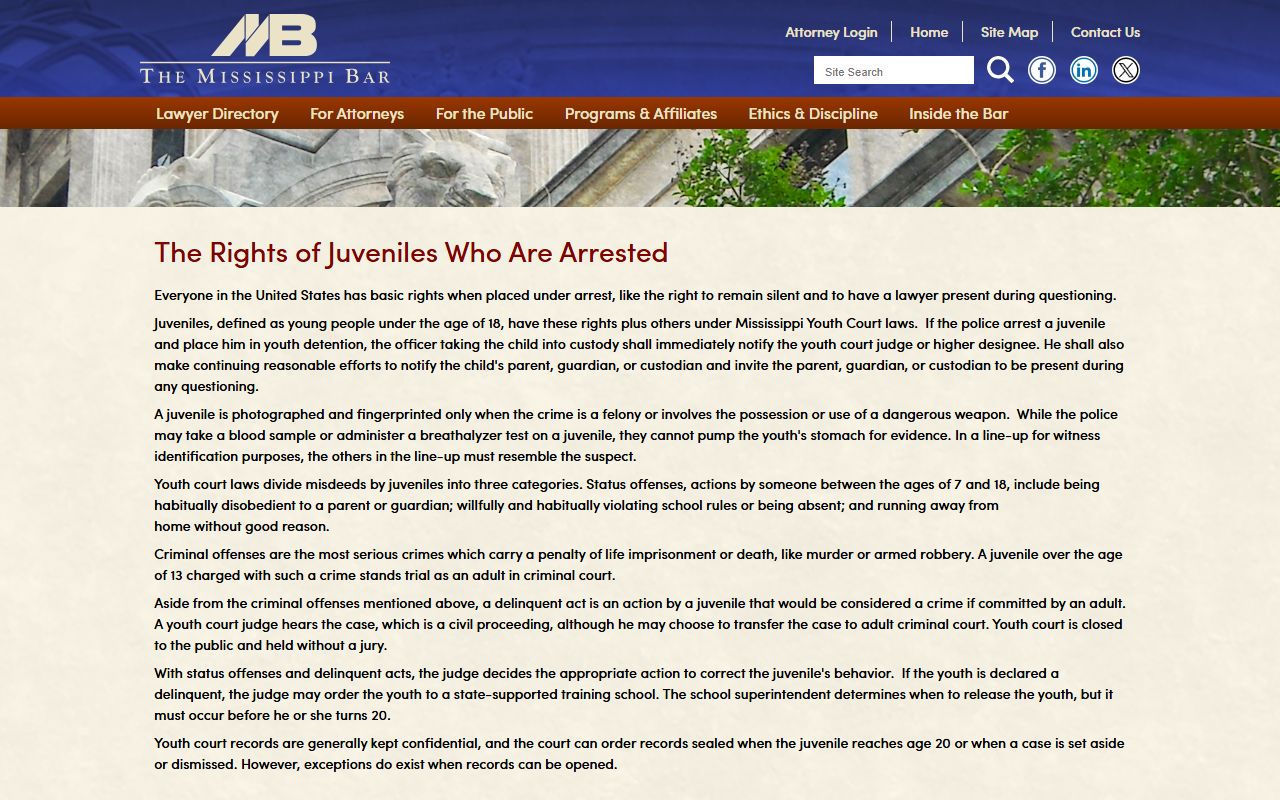
Because of these limits, a search that returns nothing does not always mean no case exists. The right next step is to ask the clerk who would hold the file. Booking and bond information sits with the Sheriff, while every court entry stays with the clerk of the court, and the broader set of Franklin County court records covers the civil side as well.