
Franklin County Arrest Records and Court Charges
A Franklin County arrest record is the record of an arrest itself. It captures the agency that made the arrest, the date, and the booking handled by the jailers under Sheriff Tom Tindle. An arrest alone does not file a charge. After someone is arrested, a prosecutor reviews the case and decides what formal charges to bring. Those charges are filed with the court clerk, and that filing is what becomes the court charge record. Arrest and charge are two different steps, kept in two different record systems.
The custody and booking side of the story lives with the Sheriff and the jail, so the jail roster and booking detail are covered on the Franklin County inmate records page. The court charges after arrest are tracked through the case file maintained by the clerk. The full outcome, including the plea, the disposition, and the sentence, sits in the broader criminal court records for the case. This page focuses on the charges that connect the two.
Federal arrests work the same way at a different level. The Federal Bureau of Prisons inmate locator shows people held in federal custody, separate from any county jail booking.
That separation matters because a county arrest and a federal hold can produce different records in different systems for the same person.
How to Find Franklin County Arrest Records and Charges
Franklin County does not host its own online case search. The charges filed in a case can be found through Public Access Mississippi Electronic Case Management, known as PAMEC, the public window into the statewide electronic-court system. Circuit and Justice Court charge entries show up there once they are filed. The arrest and booking side is not in that system. For who is in custody and the booking detail, the jail roster route on the inmate records page is the right channel.
- Open the Mississippi Electronic Courts public access registration and create an account.
- Log in and search by defendant name or by cause number.
- Open the case and read the list of charges that the prosecutor filed.
- Check each charge for its statute code, its level, and its current status.
Charges that reach a statewide criminal history are tracked by state agencies, not by a single county database. When the online system shows no remote access, the clerk who holds the file can confirm what charges were filed and how they stand.
How Franklin County Charges Get Filed After an Arrest
The arrest happens first, often at booking after an officer acts. The charge record then begins when a prosecutor files a charging document with the court. In Franklin County the path depends on the offense. Misdemeanors and felony first appearances commonly begin with a sworn affidavit in Justice Court, where the County Prosecuting Attorney Mary K. Williamson represents the State. Felonies are formally charged by indictment after a grand jury acts, and District Attorney Tim Cotton prosecutes those in Circuit Court.
One local point sets criminal charges apart from civil claims. The county courts page warns that criminal process cannot be used to collect a civil debt or money damages, citing State ex rel. Richardson v. Edgeworth, 214 So.2d 579 (Miss. 1968), a case about the abuse of criminal affidavits to force payment of debts. A person filing a complaint must decide whether the matter is a criminal charge or a civil money claim, because the two follow different courts and different rules.
| Complaint / Affidavit | Information | Indictment | |
|---|---|---|---|
| Filed By | Officer or prosecutor | Prosecutor | Grand jury |
| Common For | Misdemeanors and initial appearances | Some felonies by waiver | Serious felonies |
| Starts | The case in Justice Court | The case | The felony case in Circuit Court |
Federal charges follow a parallel track through the U.S. Attorney. The U.S. Attorney's Office for the Southern District of Mississippi prosecutes federal offenses that arise in the county.
State and federal charges can run side by side, so the same arrest may appear in more than one charging system.
Franklin County Charge Status Explained
Charges are not fixed. As a case moves, a charge can be amended, reduced, added, dropped, or dismissed. A felony can be reduced to a misdemeanor, or several counts can be folded into a plea. The status field in the record tells the reader where each charge stands right now. Nolle prosequi is a formal decision by the prosecutor not to pursue a charge. Reading the status for each count, not just the original charge, is the only way to know the real picture.
| Status | What It Means |
|---|---|
| Pending | The charge is filed and the case is still active before the court. |
| Amended / Reduced | The charge was changed, often to a lesser offense or a corrected count. |
| Dismissed | The court ended the charge without a conviction. |
| Nolle Prosequi | The prosecutor formally chose not to pursue the charge. |
Charge vs. Conviction in Franklin County
A charge is an accusation. A conviction is a finding of guilt. The two are easy to confuse in an arrest or charge record, but they carry very different weight. A Franklin County record can show a charge that was filed and later dismissed, dropped, or reduced, and that filing stays visible even though it never led to a conviction. The State must prove a charge beyond a reasonable doubt before it becomes a conviction. Until then, the entry is only a charge.
| Charge | Conviction | |
|---|---|---|
| Stage | Accusation | Verdict or plea |
| Burden of Proof | Probable cause | Beyond reasonable doubt |
| Public Record | Yes | Yes |
The plea, the disposition, and the sentence that resolve each charge are found in the full criminal court record for the case.
Sealed vs. Expunged Records
A sealed record still exists but is hidden from public view, and inspecting it usually takes a court order. An expunged record is removed from public access and treated as though the charge never happened. Mississippi expunction is governed by Miss. Code Ann. § 99-19-71, which allows certain first-offense misdemeanors and one qualifying felony conviction to be cleared after the sentence and any waiting period are complete. Serious offenses are excluded by statute, and the petition is filed in the court that handled the charge.
| Sealed | Expunged | |
|---|---|---|
| Visibility | Hidden from public | Destroyed or treated as never existed |
| Law Enforcement | Limited access | Very limited |
| Eligibility | By court order in restricted categories | Eligible misdemeanor or one qualifying felony under Miss. Code 99-19-71 |
Note: A dropped or dismissed charge is not automatically erased, and clearing it from public access still requires a separate court order or expunction.
Franklin County Charge Codes and Levels
Each charge ties to a statute, and the statute sets the level. Mississippi sorts offenses into felonies, misdemeanors, and lower violations. A felony is the most serious and is handled in Circuit Court after indictment. A misdemeanor is a lower-level offense usually heard in Justice Court or a municipal court. The severity drives the court, the possible penalty, and whether a grand jury must act. One arrest can produce several separate charges, and each can carry its own code and level.
The charge code in the record points to the exact statute the prosecutor used. Reading the code is the way to learn precisely what was alleged.
Statewide Charge and Criminal History Lookups
Charges from across Mississippi roll up into statewide systems rather than a single county list. The Mississippi Department of Corrections runs an inmate search for people sentenced to state custody, which reflects felony convictions that ended in prison time. People required to register as sex offenders appear on the Mississippi public sex offender registry, a separate statewide tool maintained by the Department of Public Safety. Neither one is a county arrest blotter.
Federal charges and case news are published by the U.S. Attorney's Office press releases for the Southern District of Mississippi.
These statewide and federal sources fill gaps the county website does not cover, but each shows only its own slice of a person's charge history.
Background Check Considerations
An informal charge lookup is not a regulated background check. Public charge entries can answer a personal question, but a report ordered for hiring, housing, or lending must follow federal rules and rely on verified, current data. A charge that was dismissed or reduced should never be read as a conviction. Anyone making a regulated decision should use a compliant consumer reporting agency, not a casual search.
Important: This site is not a consumer reporting agency under the Fair Credit Reporting Act, and its information may not be used for credit, employment, housing, or other FCRA-regulated decisions.
Restricted Charge Records in Franklin County
Not every charge is open to the public. Youth Court charges are confidential under Mississippi law, with access limited to people the statute or a judge allows. Sealed charges, expunged charges, and matters tied to an active investigation may also be withheld. Records that name minors or list sensitive identifiers are redacted before release. A search that returns nothing does not always mean no charge was filed.
The confidentiality of youth matters runs through Miss. Code Ann. § 43-21-251 and related sections, and recent legislative language on youth court access can be read in the Mississippi Senate Bill 2781 statutory text.
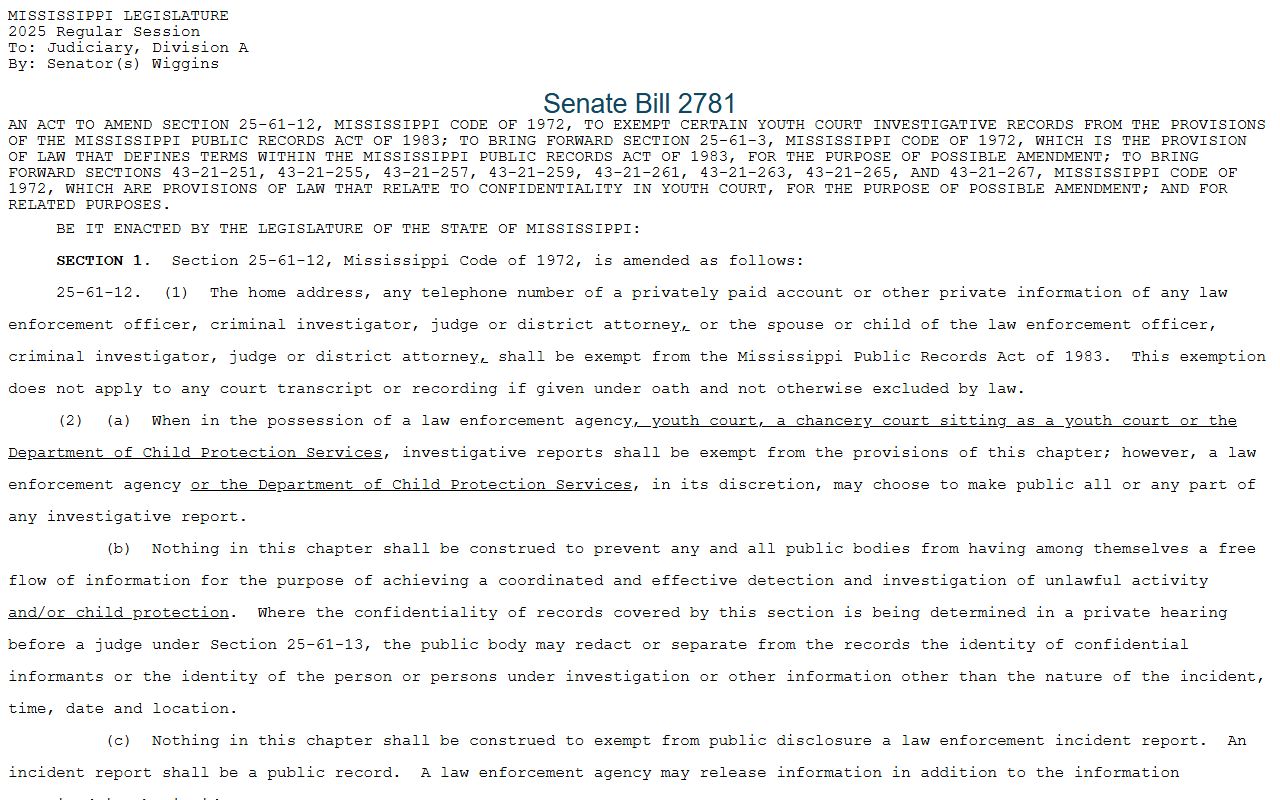
When a charge record is restricted, the right step is to ask the clerk of the court that would hold the file, since the public view may not tell the whole story.