
What Is a Court Docket in Franklin County
The docket is the index of a case. It lists each event in date order: the complaint or petition, every motion, each hearing, the orders a judge signs, and the final judgment or decree. Read top to bottom, a docket tells the story of how a case moved through the court. It does not hold the documents themselves. Those filings, exhibits, and orders make up the full case file, which sits behind the docket entries.
Franklin County does not publish a single county docket. The court level decides which calendar holds the case. Circuit Court keeps felony and civil dockets. Chancery Court keeps divorce, probate, and equity dockets. Justice Court keeps traffic, misdemeanor, and small civil dockets. Federal matters tied to the county run on a separate national docket system. Knowing the level points you to the right calendar before you search.
Why does the docket matter? It is the fastest way to confirm a court date without pulling the whole file. A docket also shows whether a case is active, closed, or on appeal. For a felony matter, the docket records the indictment, arraignment, pleas, and any sentencing order. For a Chancery case, it tracks petitions, notices to creditors, hearings, and the final decree. Justice Court dockets log citations, initial appearances, and trial dates. Reading the docket first answers many simple questions and saves a trip to the counter.
How to Find Franklin County Dockets Online
The statewide route is Mississippi Electronic Courts, and the public side is Public Access to Mississippi Electronic Case Management, or PAMEC. A registered account opens docket information, case details, and documents for participating Circuit and Chancery cases where remote access is allowed. Public users register and sign in, and the Mississippi Judiciary lists a $10 annual registration fee with per-page document charges reported at about $0.20 a page. Sealed and restricted cases may not show even when they exist.
- Open the PAMEC registration page, set up a non-attorney account, and sign in.
- Choose the participating Franklin County court, either Circuit or Chancery.
- Enter a party name or cause number, and add a date range to narrow the list.
- Review the docket entries, then open a linked document when remote access is permitted.
Mississippi completed statewide electronic filing and case management in 2025, a change the Judiciary announced in its statewide e-filing news update.  That rollout means Franklin County trial-court dockets now flow through the same electronic system used across the state.
Account help is available. The MEC Helpdesk answers registration and login questions by email at helpdesk@mec.ms.gov or by phone at 601-576-4650. A public account renews each year, and the same login reaches the participating Circuit and Chancery courts.
Sample Franklin County Docket Entry
Each line on a docket records one event. A reader can scan the column of dates to see the order of filings, then read across to learn what happened and who acted. The fields below appear on a typical Franklin County trial-court docket, though the layout and labels shift a little between Circuit, Chancery, and Justice Court.
| Field | What It Shows |
|---|---|
| Entry Date | The day the filing or court event was recorded. |
| Event Type | The action, such as motion filed, hearing set, order entered, or continuance. |
| Party Filing | Which side submitted the document: plaintiff, defendant, petitioner, or the State. |
| Hearing Data | Date, time, judge, and courtroom when a hearing is scheduled. |
| Disposition Note | Entries that record a plea, judgment, decree, or dismissal. |
| Document Link | A link to the underlying filing when remote access is permitted. |
The same docket fields feed the full case file. For a field-by-field look at the documents behind these entries, the Franklin County court records page breaks down what each part of a case file shows.
Courts That Publish Dockets in Franklin County
Several courts serve Franklin County, and each keeps its own docket. The trial courts feed the statewide electronic system, while appellate and federal courts run separate calendars. Justice Court adds a local wrinkle: its judges hold sessions at the jail three times each week so an arrested person receives an initial court appearance within three days of arrest, and those appearances show on the Justice Court calendar.
- Circuit Court District 6: felony criminal and circuit civil dockets, filed through the Circuit Clerk.
- Chancery Court District 4: divorce, probate, guardianship, and land dockets, filed through the Chancery Clerk.
- Justice Court: traffic, DUI, misdemeanor, and small civil dockets, plus three-times-weekly jail-session appearances.
- Mississippi Court of Appeals and Supreme Court: appellate dockets above the trial level.
- U.S. District Court, Southern District: federal dockets for the Western Division at Natchez.
The split matters for a searcher. A divorce or estate docket will never appear on a Circuit Court calendar, and a felony docket will never sit in Chancery. When the level is unclear, the clerk who keeps the file can point to the right court. Circuit and marriage filings start with the Circuit Clerk. Divorce, probate, land, guardianship, and youth dockets start with the Chancery Clerk. Traffic and misdemeanor dockets start with Justice Court at the county seat in Meadville.
Federal dockets tied to the county are searched through the national CM/ECF system, with a court lookup on the PACER Southern District lookup page.  PACER covers federal cases only, so Franklin County state-court dockets still run through PAMEC.
Docket vs. Full Case Record
A docket and a case file are not the same thing. The docket is the index, a short list of dated events. The full record holds the actual motions, exhibits, orders, and judgments. A reader checking a hearing date needs only the docket. A reader who needs the wording of an order, or a copy to file elsewhere, needs the document behind the entry. The table below sets the two side by side.
| Docket | Full Case Record | |
|---|---|---|
| Format | List of entries | Full documents |
| Access | Often online and free | May require fee or visit |
| Use | Track case progress | Legal review, evidence |
The Mississippi Judiciary has explained the public-access and per-page fee structure for electronic case information in its MEC public access notice.  Viewing a docket may be quick, while pulling each document behind it can carry a charge or require a clerk visit.
Access mechanics shape what a docket search returns. PAMEC asks each public user to register, sign in, and renew the account every year for $10, with document viewing billed per page at about $0.20. Scanning a docket list can be fast, yet opening the filings behind it adds up. The system also hides whole categories from remote view. Sealed cases, divorce, child custody and visitation, child support, termination of parental rights, guardianship, and conservatorship dockets may not appear online even when they exist. Circuit Court felony and civil dockets are more often open to remote viewing than these Chancery family categories. When a needed docket stays blocked online, the clerk who keeps the file can confirm whether it can be reviewed in person.
How to Read a Franklin County Docket
Dockets use shorthand. A line might read "Mot. to Continue" for a request to delay, "Ord." for an order, or "Disp." for a disposition. Mississippi case captions use "Cause No." for the case number and name the parties as plaintiff and defendant, or petitioner and respondent in Chancery matters. Criminal dockets show the State of Mississippi as the prosecuting party. Reading in date order reveals how the case advanced.
Numbers help too. A cause number ties every docket line to one case, so quoting it to the clerk gets the fastest answer. Dates anchor the sequence, and the most recent entry usually shows the current status. A docket that ends with a decree, judgment, or dismissal points to a closed case. An open string of motions and settings means the matter is still moving.
Disposition lines carry the result. A criminal docket may show a plea, a verdict, a sentence, or a dismissal. A Chancery docket may show a decree granted, an estate opened, or a guardianship closed. The progression of a serious criminal matter, from charges through sentencing, is tracked in the Franklin County criminal court records. If an entry is unclear, the clerk who keeps the file can confirm what a code or abbreviation means.
Free research tools can help with federal opinions and selected dockets, including the nonprofit CourtListener archive.  CourtListener is not the official filing system, so a Franklin County state docket still comes from PAMEC or the clerk.
Remote Access Limits on Franklin County Dockets
Not every docket is viewable from home. PAMEC may restrict remote access for sealed cases and for sensitive categories such as divorce, child custody and visitation, child support, termination of parental rights, guardianship, conservatorship, and domestic-abuse protection. Personal identifiers like Social Security numbers, birth dates, minor children's names, and financial account numbers are protected under the system's administrative rules. When a docket is blocked online, the case may still be reviewed in person at the clerk's counter unless a court order seals it.
Federal dockets follow their own access rules. News and notices from the federal trial court that serves the county appear on the Southern District of Mississippi news page. 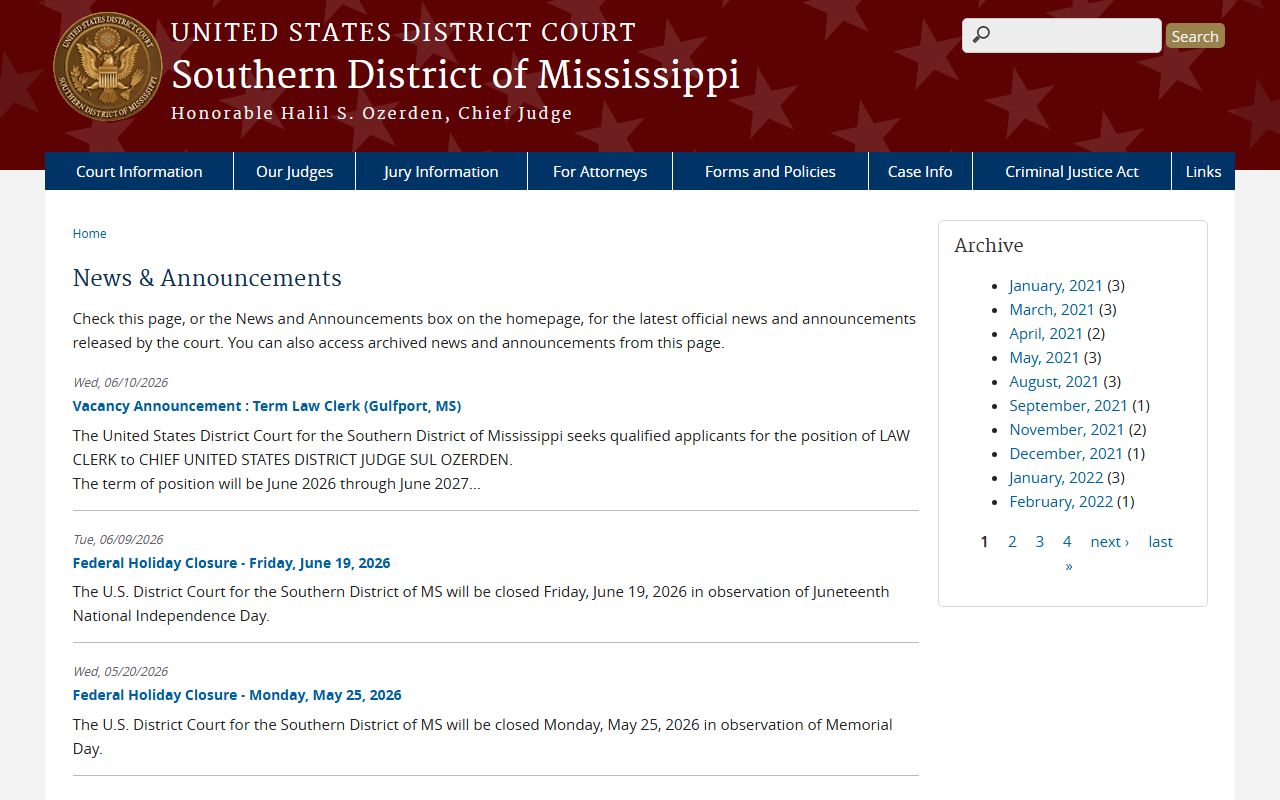 For state-court dockets, the surest path remains a PAMEC account or a direct call to the Circuit or Chancery Clerk.
Plan for the gap. If a docket does not load online, note the cause number and the court level, then call the clerk to confirm whether the file is public, sealed, or simply not yet digital. Bring a photo ID for an in-person review. Franklin County does not publish a court copy fee schedule, so confirm any certification cost with the clerk before ordering.